
Pruning
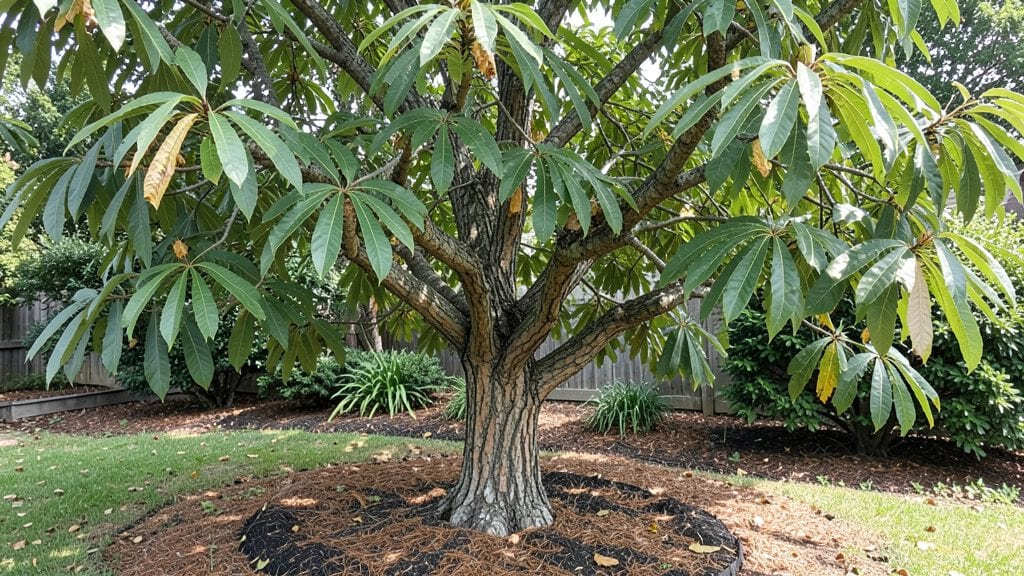
Mastering pecan tree bark identification reveals more than just its striking ridges—it’s your key to spotting hidden health secrets beneath that chocolate-brown hide. 🌳 hue, but cracks and discoloration can signal trouble.
I’ve spent years studying these patterns, and I’ll show you how to spot the subtle differences between healthy bark, disease damage, and pest infestations.
The key lies in the details: smooth vs. rough, color shifts from brown to black or gray, and the presence of oozing sap or tiny holes. For example, bacterial leaf scorch creates dark streaks along the bark, while borer damage often reveals sawdust-like frass near the base.
You’ll learn to compare these signs to a healthy tree’s bark, so you can act before problems spread.
Once you recognize the warning signs, you’ll know whether to prune affected branches, apply treatments, or call in an arborist. The goal isn’t just to diagnose—it’s to save your tree and keep it producing those sweet, buttery nuts for decades.
Let’s break down what to look for and what each clue means.
This guide works for both backyard trees and larger orchards, and the techniques apply year-round. Whether you’re a curious homeowner or a seasoned grower, these visual cues will give you confidence in your tree’s health. Ready to become a bark detective?
📚 In This Guide
- What you need
- Instructions
- Tips and common mistakes
- Wrapping up and next steps
What you need
- ● Pecan tree samples: 1-3 small twigs (6–12 inches long, pencil-thick or thinner)
- ● 1-2 bark strips (peeled from branches, ~3–6 inches long)
- ○ Optional: A few mature leaves (for cross-verification)
- ● Magnifying glass: 10x magnification (for inspecting fine bark textures and lenticels)
- ● Field guide or smartphone: A pecan tree ID app (e.g., iNaturalist or PictureThis) or a printed guidebook
- ● Notebook & pen: For jotting down bark patterns, colors, and twig details
- ● Pruning shears or sharp knife: Small, sterilized pair (for safely collecting samples)
- ● Ruler or measuring tape: 6-inch minimum (to note twig/bark dimensions)
- ● Plastic bag or envelope: For storing samples until inspection
- ● Camera with macro setting (for high-res photos of bark details)
- ● Rubbing alcohol wipes (to sterilize tools between samples)
- ● Field magnifier with LED light (for low-light bark inspections)
- ● Reference samples (pre-identified pecan bark pieces for comparison)
- ● Gloves (if handling rough or thorny branches)
How to identify pecan tree bark by species
Matching bark to the right pecan species is easier than you think—just follow these visual cues.
🌿 Step 1: Examine the Overall Bark Texture and Color
Start by looking at the trunk and larger branches of the tree. Pecan tree bark varies significantly by species, but all mature trees develop deep, rugged ridges as they age. The Shawnee pecan, for example, has dark, almost black bark with pronounced, blocky ridges that resemble alligator skin. Younger trees of this variety might show lighter gray-brown bark that darkens with age.
Compare this to the Desirable pecan, which typically displays lighter brown bark with smoother, less dramatic ridges. The bark of Cape Fear pecans tends to be medium brown with tight, interlocking plates that create a more uniform pattern. Pay attention to how the bark peels or flakes—some species like Sioux have bark that develops long, vertical cracks as the tree matures.
🌱 Step 2: Inspect the Twigs for Unique Characteristics
Move to the smaller branches and twigs—this is where species differences become clearer. Healthy pecan twigs are stout and slightly zigzagged, but the color and hairiness vary. Shawnee pecans often have reddish-brown twigs when young, which darken to a deep brown as they age. Look for fine, downy hairs along the twigs of younger trees, though these usually disappear by maturity.
The Desirable pecan typically sports lighter brown twigs with a smoother finish, while Cape Fear twigs may show a greenish tint when fresh. Twigs of Sioux pecans often have a more angular, squared-off appearance compared to the rounded twigs of other varieties. Press your fingernail into the twig—if it leaves a white mark, the wood is soft and likely from a younger tree.
☀️ Step 3: Check for Bud and Leaf Scar Patterns
Examine the leaf scars where leaves once attached to the twigs. Pecan leaf scars are half-moon shaped with a small, raised bump where the leaf stem connected. However, the size and shape of these scars can hint at the species. Shawnee pecans often have larger, more pronounced leaf scars with a distinct dark line running through the center. In contrast, Desirable pecans tend to have smaller, lighter-colored scars that blend more seamlessly into the twig.
Look at the buds too—they’re usually oval and pointed, but Shawnee buds are often longer and more tapered, while Cape Fear buds appear shorter and rounder. If the buds are hairy, that’s a clue—Sioux pecans frequently retain fine, silky hairs on their buds even into maturity. Compare these features side by side with known samples if possible.
✂️ Step 4: Verify with Leaf Shape and Arrangement
While bark and twigs are key, leaf structure can confirm your identification. Pecan leaves are compound, with 9-17 leaflets arranged in an alternate pattern. However, Shawnee leaves tend to have longer, narrower leaflets with serrated edges, while Desirable pecans often show broader, more rounded leaflets. Hold a leaf up to the bark—if the leaflets are dark green and glossy, it’s likely a Cape Fear, whereas Sioux pecans often have lighter, matte green foliage.
Run your fingers along the midrib of the leaflets. If it feels slightly fuzzy, that’s another clue—young Shawnee leaves often retain a fine downiness until late spring. Compare the leaf stem (petiole) too—Desirable pecans have shorter petioles, while Shawnee petioles are longer and more slender. Matching all three—bark, twigs, and leaves—gives you the most accurate species ID.
🔍 Step 5: Cross-Reference with Known Samples
If you’re still unsure, compare your findings to reference photos or a local pecan tree guide. Take close-up images of the bark, twigs, and leaves, then overlay them with trusted sources. Note any unique markings—like white lichen growth (common on older Shawnee bark) or black streaks (a sign of disease, not species, but worth documenting). Real talk: pecan bark patterns can vary even within the same tree, so focus on consistent traits across multiple branches.
When in doubt, consult a local arborist or extension service—they often have press collections of pecan bark samples for comparison. Bring your notes on bark color, twig hairiness, leaf scar size, and leaflet shape, and you’ll get a precise match every time. This method works for wild pecans too, just scale your observations to the tree’s size.
Tips & tricks for perfect pecan tree bark identification
Here's how to sharpen your eye for those subtle differences that make all the difference in species matching.
Lighting Matters: Always examine bark and twigs in natural daylight or under bright, even artificial light. Shadows can distort colors and hide important details like the subtle greenish tint on Cape Fear twigs or the dark lines in Shawnee leaf scars. I've learned this the hard way—trying to match bark in dim lighting led me to misidentify a Desirable as a Shawnee more than once. Morning sunlight works best for consistent results.
Compare Multiple Branches: Don't rely on a single branch for identification. Pecan trees can show variations in bark and twig characteristics even within the same tree. Focus on consistent traits across multiple branches—especially the trunk and larger limbs. For example, if you notice Shawnee's characteristic blocky ridges on one branch but smooth bark on another, look for the most common pattern to determine the species.
Seasonal Considerations: Bark and twig characteristics change with the seasons. Younger spring twigs might retain more hairiness or show brighter colors, while winter bark can appear more weathered. If you're identifying in late fall or winter, expect the bark to look slightly more faded and the twigs to be dormant. Spring and summer provide the most distinct visual cues, so that's the best time to make accurate matches.
Leaf Scar Close-Up: Use a magnifying glass or your phone's camera to get a closer look at leaf scars and buds. The subtle differences in size, shape, and color patterns become much clearer when magnified. Shawnee's distinct dark line through the leaf scar or Sioux's silky bud hairs are details that are easy to miss without magnification. I keep a small magnifier in my field kit specifically for this purpose.
Pro Tips for Pecan Tree Bark Identification
- Here's how to sharpen your eye for those subtle differences that make all the difference in species matching.
- Lighting Matters: Always examine bark and twigs in natural daylight or under bright, even artificial light.
- Compare Multiple Branches: Don't rely on a single branch for identification.
Frequently asked questions
Got questions about pecan tree bark? You’re not alone! Here are some of the most common inquiries to help you identify and care for your tree with confidence.
What does healthy pecan tree bark look like?
Healthy pecan bark is thick, dark gray to brown, and develops deep, diamond-shaped ridges as the tree matures. Young bark is smoother, while mature trees show furrowed, scaly patterns. Avoid trees with peeling, sunken, or oozing bark—these could signal disease or pests.
When is the best time to identify pecan bark?
The ideal time is late winter or early spring (before buds swell) or fall (after leaves drop). Bark details are most visible when the tree isn’t leafy, and you can compare it to reference photos. Avoid wet conditions—moisture can obscure textures.
How do I tell a pecan tree apart from hickory or walnut?
Use this quick bark comparison:
Tree Type
Bark Texture
Key Feature
Pecan
Thick, diamond-ridged
Deep grooves, scaly plates
Hickory
Shaggy, plate-like
Ridges peel into long strips
Walnut
Thin, furrowed
Smoother than pecan, blocky ridges
Pro tip: Check for buds—pecan buds are large and hairy!
What does damaged or diseased pecan bark look like?
Watch for peeling, blackened, or wet-looking bark—signs of bacterial blight or silver leaf fungus. Cankers (sunken, dead patches) or sawdust-like frass (from boring insects) mean pests. If you spot these, prune infected areas 12 inches below the damage and disinfect tools.
Can I use pecan bark for mulch or compost?
Yes! Pecan bark is excellent mulch—it’s slow to decompose and retains moisture well. For compost, shred it first (whole chunks slow the process). Avoid using bark from diseased trees—it can spread pathogens. Bonus: It adds a nutty aroma to garden beds!
Wrapping up and next steps
Identifying pecan tree bark is an empowering skill—whether you're a gardener, forager, or simply curious about nature! 🌳 By mastering the differences in texture, color, and patterns, you can confidently match species and even spot potential pests or health issues early.
Now that you’re equipped with the know-how, why not take the next step?
🌱 Next Steps:
- Visit a local pecan grove—observe trees up close and compare what you’ve learned.
- Document your findings with photos or a journal to track growth and changes.
- Share your knowledge with fellow plant enthusiasts or gardening groups!
Happy exploring—your pecan tree adventures are just beginning! 🌿